What Makes VALORANT Champions Shanghai Group Stage Day 8 the Best Watch for Playoff Clues
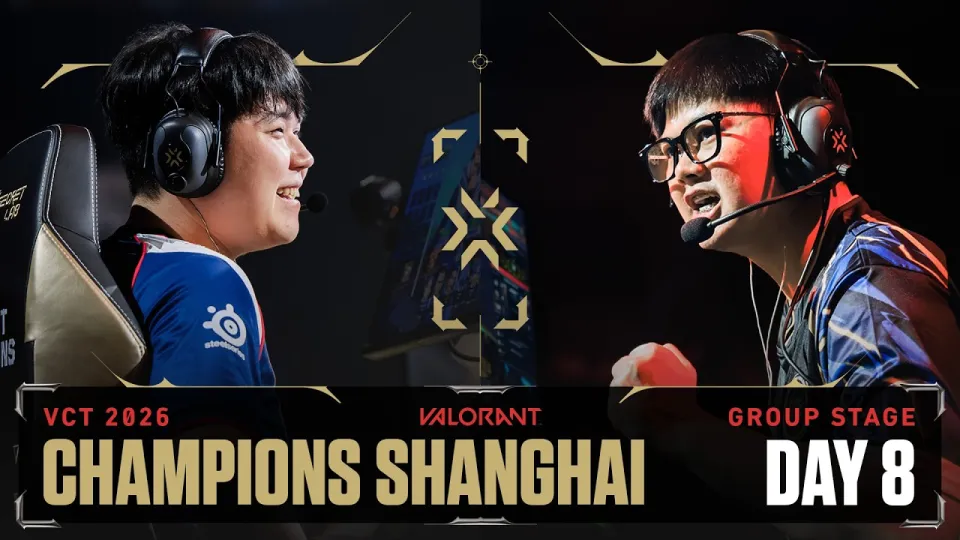
Video: VALORANT Champions Shanghai — Group Stage — Day 8
Want articles like this for your own video to promote it on YouTube and Google? Order them through the Telegram bot @sat_sit_bot. Articles with your video embedded are written and posted by the bot itself — on popular topical sites (no ads). Your first 50 articles are free.
· based on the channel VALORANT Champions Tour
VALORANT Champions Shanghai Group Stage Day 8 is the single best VOD to watch if you want to understand why the CN region collapsed at its own international event, because it contains both the closest near-upset of the group stage and the cleanest demonstration of how quickly a lead evaporates against a top-tier opponent. The broadcast, published by the VALORANT Champions Tour channel on October 2, 2026, packages T1 versus JD Gaming across three maps plus the day's earlier series, and the official VALORANT Esports Twitter/X account is the fastest place to catch the bracket and schedule updates that the VOD cannot show you.
What Day 8 of the VALORANT Champions Shanghai group stage actually contains
Day 8 is a two-series broadcast block, and its runtime is the reason it works as a study tool rather than background noise. The first series opens at 35:56 after the pre-show, and the day's headline matchup — T1 against JD Gaming — is broken into three distinct maps. The stream is dense with the small decisions that decide international matches: pistol round economy, retake discipline and the mid-round calls that separate a 13-11 win from a 13-11 loss.
- Opening series Game 1 begins at 35:56.
- A Tech Pause halts play from 1:15:49 to 1:16:51.
- T1 vs JD Gaming Game 1 starts at 2:37:45.
- Game 2 starts at 3:48:17.
- Game 3, the decider, starts at 4:28:42.
Why the JD Gaming 6-11 collapse is the defining moment of the day
JD Gaming's map one against T1 is the closest a Chinese team came to a statement win on home soil, and the way it slipped is the most instructive sequence in the entire VOD. Holding a 6-11 lead in a game where CN teams have historically struggled to close against Pacific opposition is already an outlier; losing it is the kind of detail that decides whether a roster is remembered for progress or for another group-stage exit. The third map then became a formality in the wrong direction, and the scoreline flattened a series that was genuinely competitive for two maps.
For coaches and analysts, the replay value sits in the buy decisions JDG made while ahead. A 6-11 cushion in VALORANT is not safe when the opponent can force-buy into a favorable site and convert, and T1's ability to claw back rounds without full utility is exactly the pattern that separates playoff teams from teams that go home early.
The CN region problem that Shanghai exposed
The most-discussed storyline around Day 8 is not a single round but a regional result: every Chinese team at Champions Shanghai was eliminated during the group stage. That outcome is uncomfortable precisely because the event is being played in Shanghai, and the community reaction split into two camps — one arguing that home pressure and a young player pool were the cause, another pointing out that CN teams receive direct VCT slots and therefore carry an expectation to convert them into playoff appearances.
A few concrete factors explain the gap better than a vague "regional curse" label:
- Opponent depth. Americas, EMEA and Pacific rosters arrived with more international series behind them in 2026, including two Masters events won by new champions.
- Closing experience. Losing a 6-11 lead is a nerves-and-communication failure as much as a tactical one, and it repeated across the region's representatives.
- Slot pressure. Direct slots remove the qualifying grind that forces teams to sharpen their map pools against varied opposition.
The counterargument is worth stating fairly: a single group stage on home soil is a small sample, and the region's mid-table teams have shown they can take maps off elite opponents. The correct read is that CN is not far behind in raw aim, but is behind in the specific skill of winning a series that has already turned tense.
Roster experiments and role swaps worth rewatching
Day 8 also produced one of the more debated coaching decisions of the group stage: fielding a player known for a non-duelist role on a duelist agent. Role flexibility is increasingly normal in professional VALORANT, but moving a player into the entry role at an international event changes the entire utility economy of a team — who takes space, who trades, and who is left to anchor a site alone.
When you rewatch, track three things rather than the scoreboard:
- Which player actually takes first contact on attack rounds.
- How often the new duelist receives a flash or recon before entrying.
- Whether the team's post-plant setups change because of the swap.
If the entry player is consistently isolated, the swap is costing rounds regardless of individual statistics. If the team layers utility for them, the experiment is functioning and the scoreline is a separate question.
Common questions viewers asked during the broadcast
Several recurring doubts come up in the chat around this VOD, and they are worth answering directly because they shape how you read the rest of the group stage.
Hit registration and damage numbers. When a spectator overlay shows two bullets landing on a model that appears to take three, the usual explanation is a combination of server-side tick timing, wallbangs that do not render visibly on the spectator client, and the fact that the broadcast overlay is not the authoritative game state. The replay is a visualization, not a log.
Silencing a key ultimate. Rounds where a signature ability like a Crown-style zone gets shut down before it can generate value are the most satisfying to watch because they represent a full read of the opponent's plan, not just a mechanical outplay. Denying an ultimate is worth more than a highlight kill.
Crowd and venue atmosphere. A quiet arena during a home-region match is a real phenomenon, and it usually reflects tension rather than disinterest — the audience knows the stakes and reacts late to big rounds.
Tech pauses. A pause between 1:15:49 and 1:16:51 in the stream is a technical stoppage, not a tactical timeout, and it does not consume a team's timeout budget.
How to use this VOD if you are trying to improve
Watching a five-hour broadcast passively teaches very little; watching it with a single question in mind teaches a lot. Pick one of the following and stick to it for the whole series:
- Economy discipline: pause before every buy round and predict the purchase before the overlay appears.
- Retake structure: note how many players commit to a retake and from which angles.
- Mid-round calling: identify the round where a team abandons its original plan and how quickly the rest of the roster adapts.
- Post-plant positioning: track crossfires rather than individual aim duels.
This is also the reason the group stage matters more than its reputation suggests: playoff seeding is decided here, and a team's map pool is exposed under pressure before it can hide behind a single comfort pick in a knockout bracket.
Useful links
- Official VALORANT Esports updates: https://x.com/valorantesports
- Facebook: https://www.facebook.com/ValorantEsports/
- Instagram: https://www.instagram.com/valorantesports/
- TikTok: https://www.tiktok.com/@valorantesports
- Twitch: https://www.twitch.tv/valorant
Final verdict on the Day 8 broadcast
Day 8 is the most valuable group-stage VOD from Champions Shanghai because it captures both sides of the same story: a Pacific heavyweight surviving a scare and a home-region roster proving it can build a lead but not yet hold one. The JD Gaming collapse on map one and the flat third map tell you more about the current state of CN VALORANT than any single highlight reel. The VALORANT Champions Tour channel produced this broadcast and it remains the primary source for the full group stage, so follow the official VALORANT Esports Twitter/X account for the playoff bracket, schedule changes and live results as the event moves toward its conclusion.
Key takeaways
- The Day 8 broadcast runs roughly five hours and covers two series: one opening match plus T1 vs JD Gaming across three maps.
- A Tech Pause interrupts Game 1 between 1:15:49 and 1:16:51 of the stream.
- T1 vs JD Gaming goes the distance: Game 1 at 2:37:45, Game 2 at 3:48:17, Game 3 at 4:28:42.
- All four Chinese teams at Champions Shanghai were eliminated, with JDG's blown 6-11 lead on map one the closest call.
- The event runs September 24 to October 18 with sixteen teams from Americas, CN, EMEA and Pacific.
Source: VALORANT Champions Shanghai — Group Stage — Day 8 · Markdown version
Questions & answers
Did JD Gaming really have a chance to beat T1 2-0?
Yes, on paper they did. JDG built a 6-11 lead on the opening map, which is a rare position for a CN team against Pacific opposition at an international event, and they lost it before dropping the third map as well. Converting that map would have put T1 under real pressure in the series.
Why were all four Chinese teams eliminated in the group stage of Champions Shanghai?
The short answer is a mix of closing experience and opponent depth. CN rosters receive direct VCT slots, which reduces the qualifying grind that sharpens map pools, and several of them lost leads in tense late-round situations. A single group stage is a small sample, but the pattern repeated across all four teams.
What was the Tech Pause during Day 8 about?
The pause occurred between 1:15:49 and 1:16:51 of the broadcast and was a technical stoppage, not a tactical timeout. It does not count against a team's timeout budget, and play resumed without a change to the series format.
Is it worth watching the full five-hour VOD or just highlights?
Watch the full VOD if you want to study economy and retake structure, because highlights strip out the buy rounds that decide maps. If you only care about the result, the T1 vs JD Gaming block starting at 2:37:45 covers the day's most competitive series.